A VISUAL GUIDE THROUGH PRADO MUSEUM
THE DRUNKS
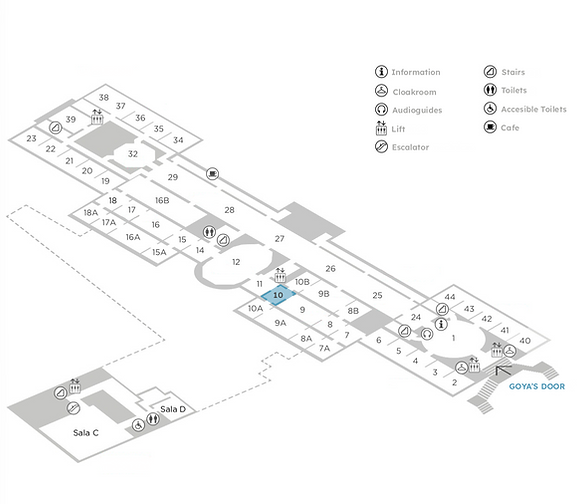
ROOM 010
Floor 1
Velázquez


You are looking at a guide about trust. In these paintings, the main idea is how humans created classical myths to explain or compare them with real life. The goal is to teach a moral lesson to the viewer.
This specific painting, "The Drunkards", shows us that myths were not always tragic or educational. They also represent ordinary or even trivial things. This is a direct reflection of reality, mixing the divine world with the mortal world.
Painting audio guide:
Audio made by Miguel Catalán highschool students Adelina and Lucia
Audio transcription:
“The Drunks is a painting by Diego Velázquez created between 1628 and 1629. It measures 165 by 225 centimeters, is painted with oil on canvas and is located in the Prado Museum at the room 010. The scene shows the god Bacchus crowning a group of drunk peasants with wine leaves. On the left, Bacchus appears almost naked and lit by a strong light coming from that side. In the center, he places a crown on a kneeling drunken man. Around them, several men dressed mostly in black clothes and holding cups and clay jugs. The light especially highlights the central figure. The painting used mostly earth tones such as browns and ochres, although brighter colors appear in the center, like white, red and yellow. Velázquez used contrast of light and shadow and a slight sense of aerial perspective in the background. The work belongs to the Spanish Baroque and is known for its realism and naturalism. Velázquez mixed the divine with the everyday. He showed the god of wine among ordinary men, which can be seen as a reinterpretation or critique of classical mythology. He painted this shortly after moving to Madrid, where he saw many Italian mythological paintings. These inspired him, but he chose a more realistic, down-to-earth style. The painting, made for King Philip IV's court, combines the classical Bacchus with the popular peasant. It conveys the pleasure of wine and reflects the Spanish Golden Age culture, which valued a more human and realistic view of life instead of the idealized heroes of ancient mythology. Cheers!"
Did you know that...
Curiosity 1
Velázquez was a master at representing different textures. That is why in almost all of his paintings, you will find objects like plates, jars, or bowls made of clay, metal, or glass (sometimes all three together!). This painting is no exception; look closely at the ceramic jug and the crystal glass to see his incredible skill.
Curiosity 2
For the characters in this work, Velázquez likely used real models who were already drunk. They were probably servants or young men who frequently drank too much wine. You can guess this by looking at their red cheeks and their swollen, colorful noses.
Curiosity 3
One interesting theory about this painting is that it represents an allegory of time. The past is shown by the characters who are already wearing crowns. The present is the man being crowned by the god Bacchus at this very moment. Finally, the future is uncertain and is represented by characters with blurry faces, like the man standing up in the background.
To know more follow...
@here.you_art