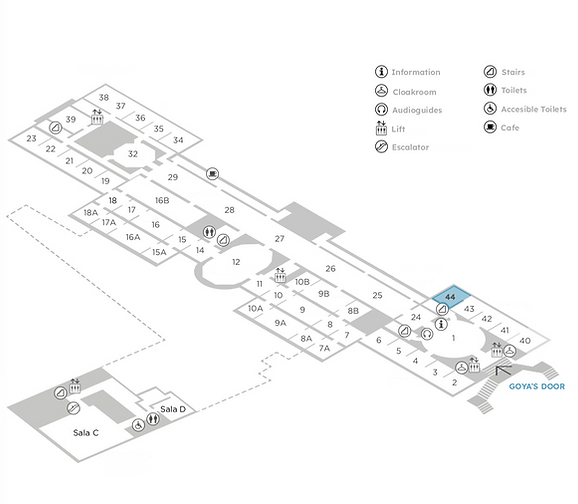
A VISUAL GUIDE THROUGH PRADO MUSEUM
DANAË AND THE SHOWER OF GOLD
ROOM 044
Floor 1
Titian


You are looking at a guide about trust. In these paintings, the main idea is how humans created classical myths to explain or compare them with real life. The goal is to teach a moral lesson to the viewer.
This specific painting, "Danaë and the Shower of Gold", shows us how gods act like humans, but with infinite power and no consequences. They can change the world however they want.
Did you know that...
Curiosity 1
A key detail in this work is the representation of the golden rain. Instead of simple drops, the gold is painted as flat, round shapes that look like coins. This represents a direct "bribe" or blackmail between the young woman's guardian and the god Zeus.
Curiosity 2
The decision to paint the servant as an old woman is not an accident. Titian uses her as a tool for contrast: her age and appearance make Danae’s beauty, youth, and her comfort with her own nudity stand out even more.
Curiosity 3
Paintings like this were reserved for a very elite audience and were kept in private spaces, such as palaces or artist studios. This painting was actually saved from being burned after an order by King Charles III. Later, it was moved to the "Sala Reservada" (The Restricted Room) in the Prado—a room full of nude paintings that were considered "dangerous" or scandalous at the time.
To know more follow...
@here.you_art


Painting audio guide:
Audio made by Miguel Catalán highschool students Dario and Nico
Audio transcription:
“The description of what we can see: The painting shows Danaë, a woman who is lying naked on a bed, and a golden rain falls on her which represents Zeus, the god coming to her in form of gold. The setting: The background of the painting is dark which makes Danaë the main focus. The room looks very rich and luxury with expensive-looking fabrics. The mood and emotion: The painting has a calm and dreamy feel. Danaë looks peaceful, almost like she is enjoying the moment. The details: The golden rain that falls onto Danaë is bright and shiny and it contrasts with the darker colors around her, making her figure stand out. The location: We have two locations. The real location of the painting that is located in the Museo del Prado in Madrid, and we have the... the place where is Danaë, that is in a maybe a palace, we don't know exactly. And the painting is large, which helps to make the viewer feel like they are right there in the scene with her. The materials: The painting is made with oil paint on canvas. This allows the artist to create the soft and glowing look of Danaë and the bright golden rain. Light and colors: The artist uses warm colors, especially gold, red and brown. The golden rain looks bright and almost magical, while the shadows around Danaë making her figure stand out. The perspective: Titian uses shallow depth in the painting, meaning that Danaë is very close to the viewer, while the background is simple and dark. The golden rain seems to be falling toward us, which adds some movement. The movement: The golden rain flows down toward Danaë, which gives the painting a sense of motion. Danaë, however, is still and calm, which creates a contrast between the stillness of her body and her movement of the rain. The author: Titian was a famous painter from Venice during the Renaissance. He was known for his skill with colors and light, and he often painted portraits and mythological scenes. The painting was created around 1554, a time when artists focused on realism and showing the human... the human body in a natural way. It was also a time when mythology was a popular subject in art. The style: Titian is famous for his Venetian style with focus on using vivid colors and soft light. His style was also very realistic, and he was known for painting beautiful natural skin tones and fabrics. The context: The painting shows the Greek myth of Danaë. In the myth, Zeus visited her in the form of golden rain because her father, King Acrisius, wanted to stop a prophecy that her son would kill him. This story is about divine intervention and fate. Why it's important: This painting is important because it shows Titian's skill in using oil paint to create beautiful textures and light. It also shows his ability to capture the beauty of the human form in a natural and intimate way. The painting reflects the Renaissance interest in mythology and beauty. It also shows how art was used to tell stories about the gods and their influence on human lives. The symbolism: The golden rain can represent both fertility and the power of the gods. Danaë's calm and passive position could symbolize how people in mythology often had no control over their fate. The cultural context: This painting was likely commissioned by a wealthy patron, possibly someone from the Venetian elite. It reflects the luxury and the intellectual interest of the time when the myths of the ancient world were used to discuss more personal or philosophical themes. And the conclusion: Danaë and the Shower of Gold is a very important painting from the Renaissance period. It shows Titian's talent with color and light, and tells a mythological story in a way that feels personal and intimate. This painting is still admired today for its beauty, its technical skill and the way it connects art with mythology and human experience."