
A VISUAL GUIDE THROUGH PRADO MUSEUM
THE SURRENDER
OF BREDA
ROOM 09A
Floor 1
Velázquez


You are looking at a guide about power. In these paintings, the main idea is our need for power when we face external forces that we cannot control. It also shows how fear is deeply connected to this concept.
This specific painting, "The Surrender of Breda", shows us how the power to win is established through direct confrontation on the battlefield.
Did you know that...
Curiosity 1
This painting is not based directly on the historical events that happened in the city of Breda. Instead, it was inspired by a play written by Calderón de la Barca, which premiered shortly after the actual battle took place.
Curiosity 2
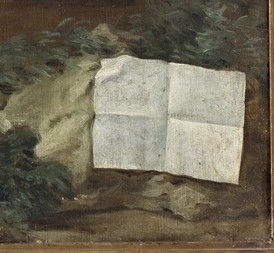
Just like in the equestrian portrait of King Philip IV, Velázquez painted a piece of paper in the bottom right corner. As in the King's portrait, this paper remains blank. By leaving it empty, Velázquez is claiming he is the creator of the work without needing to sign his name.
Curiosity 3
There is a very interesting detail among the Dutch soldiers. Besides a possible self-portrait of Velázquez himself, we can find another familiar face. It is the same profile used for the god Apollo in another of his famous paintings, The Forge of Vulcan.
Painting audio guide:
Audio made by Miguel Catalán highschool student Daniel Escalante
Audio transcription:
"Hello, I talk about The Surrender of Breda. Its author is Diego Velázquez and they are in the room 9A. The artist adopted his mother's surname in Andalusia. Since his work, Diego Velázquez, he studied and participated in the art of painting in his hometown until the age of 24, when he moved with his family to Madrid and entered the service of the king. He remained there until his death in 1660. The painting is originally called The Surrender of Breda, because on June 5 in 1625, Justin of Nassau, the Dutch governor of Breda, handed over the keys to the city to Ambrosio Spinola, the general in command of Flanders. The work was created in 1634. In the bottom right, his signature represents with a paper. Not to kill before general to demonstrate that they don't mistreat their rivals. And there are two characters there looking at the people they are seeing. The painting is located in the kingdom of Flanders, now Benelux. Velázquez adopted in this paint Baroque techniques such as glass, transparent layers of color to add nuance and depth, and chiaroscuro contrasting the light and shadow for volume. And palette of mineral pigment that achieves effect to lessen realism. The main characters are the Spanish general Ambrosio Spinola, who receives the keys to the city, and the Dutch governor Justin of Nassau, who hands them over with a gesture of respect. And includes a possible self-portrait of Velázquez and the king Carlos, Solomon of the Sea, the king of Flanders."
To know more follow...
@here.you_art


