A VISUAL GUIDE THROUGH PRADO MUSEUM
THE BOY FROM VALLECAS
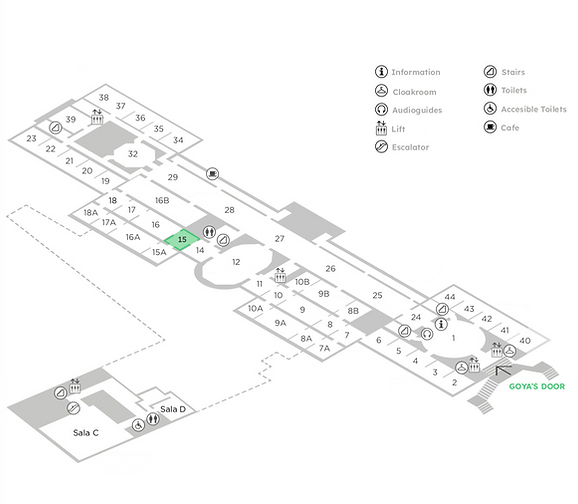
ROOM 015
Floor 1
Velázquez

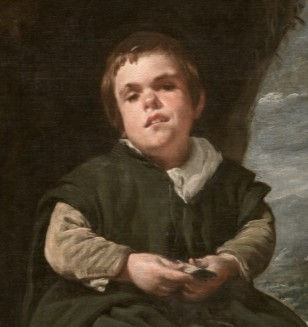
You are looking at a guide about the gaze. In these paintings, the main idea is the human need to search for an identity. This is done so we can be seen and perceived by others. At the same time, these works show how a person’s public image and their real identity rarely match.
This specific painting, "The Boy from Vallecas", shows us a marginal figure of society. It is an example of an identity that has been blurred over time.
Did you know that...
Curiosity 1
The person in the painting was actually named Francisco Lezcano, and he was originally from Biscay (Spain). The nickname "The Boy from Vallecas" was given to the portrait at the Royal Palace many years after Velázquez had passed away.
Curiosity 2
The subject of the painting has achondroplasia (a type of dwarfism) and an intellectual disability. Velázquez did not paint him to make fun of him or as a caricature. Instead, he painted him with dignity, which served as an inspiration for future artists like Goya.
Curiosity 3
In 1819, when the Museo del Prado created its first catalog, this painting was titled "A Silly Girl." It wasn't until the next catalog in 1828 that they changed the name, after realizing the person in the portrait was actually a man.
To know more follow...
@here.you_art


Painting audio guide:
Audio made by Miguel Catalán highschool students Keyla and Leire A
Audio transcription:
"The painting known as The Boy from Vallecas, also called Francisco Lezcano, was created by Diego Velázquez between 1635 and 1645. It belongs to the Spanish Baroque, a style characterized by realism, dramatic use of light and shadow, and the psychological depth in the depiction of figures. Velázquez, as court painter to King Philip IV, developed a pictorial language that went beyond conventional portraiture. In this work, he portrays a court jester with an introspective and melancholic gaze, far removed from caricature or mockery. Velázquez confronts us directly with the physical and psychic reality of his character, setting him in a very first plane, and making it so that the principal spotlight of the pictorial and luminic attraction are the two most expressive parts of his anatomy: his face of ambiguous expressions and his hands, which appear to be manipulating a deck of cards. From all the jester portraits of Velázquez, this comes to have the most known literary fortune. The painting fulfills a dual function. On the one hand, it documents court life, since jesters and dwarfs were part of the royal household; on the other, it reflects a symbolic and humanistic intention, dignifying a marginalized figure and revealing his humanity in a context that used him for entertainment. This sensitivity is one of the hallmarks of Velázquez's Baroque art, which moves away from Renaissance idealism to embrace a more raw and authentic representation of reality. The painting was part of a series of portraits of jesters and dwarfs at court, and was originally displayed in the Torre de la Parada, a royal hunting lodge. There it had a decorative role, but also contributed to showing the diversity of individuals surrounding the monarch. Unlike the caricatures common at the time, Velázquez portrayed Lezcano with dignity and psychological depth, transforming the work into a symbol of empathy and respect for those who were mocked. Regarding materials, Velázquez used a linen canvas, flexible and resistant, ideal for large-format portraits. Oil paint allowed him to apply layers with effects of light, texture and depth. His brushwork is described as loose and expressive, especially in the landscape and clothing, that conveys the sitter's melancholy. In this painting, we see one of the various portraits he used to make of the jesters of the court for practicing his line. We notice the subject of the painting has a disability as he is a dwarf. Also in the picture, he is in a sort of bed with sheets and a pillow under him as he is very little. The technique employed is oil on canvas, which enabled Velázquez to work with layers and achieve chiaroscuro effects that give him volume and realism. His brushstrokes are free and expressive in the background and clothing, while the face is treated with greater care to reflect introspection and sadness. The subdued palette of ochers, browns and muted greens is typical of his mature style and reinforces the sober tone of the composition. The dimensions of the painting are 107 centimeters high by 83 wide. It is a full-body portrait, typical of the 17th-century court painting, but relatively small compared to the royal portraits. This more intimate scale reinforces the emotional closeness of the work, distancing it from the monumentality of official portraiture. In conclusion, The Boy from Vallecas is much more than a court portrait. It is a reflection on human dignity and marginalization, a testimony to Velázquez’s sensitivity and ability to humanize those whom society excluded. His melancholic gaze still speaks to us today, inviting us to recognize the humanity in those considered different."