
A VISUAL GUIDE THROUGH PRADO MUSEUM
QUEEN JUANA LA LOCA
ROOM 075
Floor 0
Pradilla


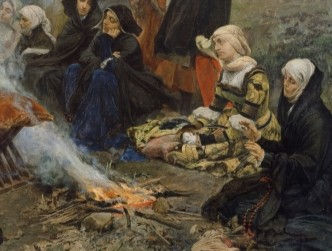
You are looking at a guide about the gaze. In these paintings, the main idea is the human need to search for an identity. This is done so we can be seen and perceived by others. At the same time, these works show how a person’s public image and their real identity rarely match.
This specific painting, "Queen Juana La Loca", shows us how, throughout history, many identities were constructed by the spectator, and not by the protagonist. It is the collective gaze that defines us, and it makes us ask, what truly identifies us?
Did you know that...
Curiosity 1
This painting shows the deep sadness and emptiness felt by Joan "the Mad", daughter of the Catholic Monarchs and Queen of Castile, after the sudden death of her husband, Philip the Handsome. Philip's final wish was to be buried in Granada. Overwhelmed by grief and pregnant with her daughter Catherine, Joan began a long journey across Castile to bury him. She reportedly opened his coffin many times because she was afraid his body wasn't there.
Curiosity 2
The scene takes place during a stop on their journey. Usually, the funeral procession would rest in a convent. However, the nearest convent (visible on the right side of the painting) was for nuns. Joan ordered her husband's body to be moved outside into the open fields instead. Everyone suffered from the freezing Castilian winter, including strong winds that made it impossible to start fires for warmth.
Curiosity 3
If you look closely at Joan’s left hand, she is wearing two rings, which represent her recent widowhood. At the same time, her belly is rounded, showing that she is in the late stages of pregnancy. This is actually the center of the painting, acting as a symbol of life after death.
Painting audio guide:
Audio made by Miguel Catalán highschool students Adrián E and Raquel
Audio transcription:
"The author of the painting is Pradilla, who painted a young widow Juana la Loca suffering the cold Castilian landscapes and the death of her husband Felipe el Hermoso, her greatest love. About the people around them, we can see that they are tired and not really emotional about the death of their monarch, and about the vegetation is mute without life. The painting Doña Juana la Loca was made in 1877 by a painter named Francisco Pradilla, who lived from 1848 to 1921. He was a Spanish artist and director of the Royal Academy of Spain in Rome and the Prado Museum. He is considered to be one of the leading exponents of Spanish painting in the last quarter of the 19th century. He was born in Villanueva de Gállego and was brought up in a modest family. When he was 11 years old, he moved to Zaragoza, where he started his studies, but he had to leave school in 1861. After that, he restarted his art studies when he joined Mariano Pescador's workshop as an assistant. Later, he also enrolled in the School of Fine Arts in San Luis. Furthermore, in 1866 he transferred to Madrid to complete his formation at the Higher School of Painting and Sculpture, where he also worked as a copyist in the Prado Museum records. Moreover, after the progress he made in the Prado records department, he had the opportunity to collaborate with several illustrated magazines of the time. In 1874 he moved to Rome, where he lived for three years and gained international recognition. He was given the Medal of Honor of the 1878 National Fine Arts Exhibition with the piece of artwork we are studying, Doña Juana la Loca. Lastly, during his career, he accepted multiple working positions, including being director of the Prado Museum. However, he finally decided to dedicate his time exclusively to painting. He died in Madrid the 1st of November of 1921. Other famous and relevant paintings of his are the Capitulation of Granada, The Sight of the Moor and Under the Tree Consecrated to Ceres. Moving on to talk about the material and dimension, it is an oil painting on canvas measuring 340 centimeters high and 500 centimeters wide. It belongs to Romanticism and the most striking part of it is its incredible composition, where the author manages to integrate rhythm, harmony and setting that are both theatrical and realistic at the same time. The author uses perspective, emotional expression, symbolism and realism to catch the attention of the viewer. Finally, the objective of the work is to show the aftermath of unrequited love between the monarchs and represents the passion, tragedy and obsession the Queen faces."
To know more follow...
@here.you_art


