A VISUAL GUIDE THROUGH PRADO MUSEUM
THE NOBLE MAN WITH
HIS HAND ON HIS CHEST
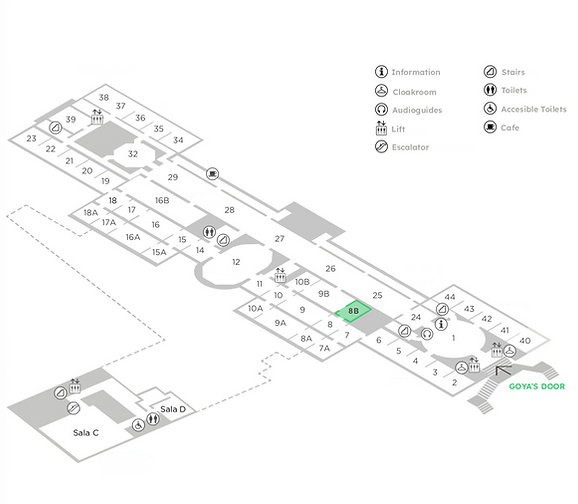
ROOM 08B
Floor 1
El Greco


You are looking at a guide about the gaze. In these paintings, the main idea is the human need to search for an identity. This is done so we can be seen and perceived by others. At the same time, these works show how a person’s public image and their real identity rarely match.
This specific painting, "The Nobleman with his Hand on his Chest", shows us a classic example of the ideal man during the Spanish Golden Age. He is an exemplary figure for society.
Did you know that...
Curiosity 1
The big mystery behind this painting is the identity of the person El Greco painted. For a long time, people thought it could be a self-portrait or even a portrait of Miguel de Cervantes, the author of “Don Quijote”. Today, although we are not 100% sure, experts believe the man is Don Juan de Silva y Ribera. King Philip II appointed him as a high official and mayor of the Alcázar of Toledo.
Curiosity 2
The detail of the hand on the chest, with the middle and ring fingers joined together, suggests that the man is making a vow or an oath. However, this hand position is not a coincidence; it appears in many of El Greco’s works. It is considered a unique symbol of his style, almost like a visual signature.
Curiosity 3
The background of the painting did not always look the way it does now. Before its restoration in 1998, the background was completely black. Thanks to the original grey background, the figure stands out more and becomes even more mysterious, inviting us to keep our eyes fixed on him.
Painting audio guide:
Audio made by Miguel Catalán highschool students Saul, Aitor and Diego
Audio transcription:
"The painting The Nobleman with his hand on his chest is one of the most famous works by El Greco. When we look at it carefully, we can see a man dressed in black, wearing a typical 16th century Spanish white cloth around his neck. His right hand is placed on his chest, so in a gesture of sincerity or loyalty. His face is serious, with an intense expression and the background is dark, which makes his figure stand out even more. The work represents a nobleman, possibly a knight or member of the Spanish court. The theme of the painting is portrait, and it reflects dignity, honor and spirituality, typical values of the 16th century Spain. The painting was made between 1578 and 1580, and is kept in Museo del Prado in Madrid. Its dimensions are 81 by 66 centimeters. It was painted on canvas and using oil painting. The light in the painting is artificial. It comes from an invisible source that illuminates the man's face and hand, creating a strong contrast between light and shadow. This technique is called light-dark. The colors are cold and dark, mainly black, white and grey, which give the portrait a mysterious atmosphere. There is almost no perspective, since the backroom is neutral and dark. The composition is very balanced and static, focusing all the attention on the face and the hand. The figure is placed in the center, creating a sense of calm. The author El Greco was born in Crete in 1541. He worked in Italy before moving on Spain, where he lived in Toledo until his death in 1614. El Greco's style is unique; he mixed Byzantine tradition, Renaissance techniques and a very expressive and spiritual style that anticipates Mannerism. The painting belongs to the Spanish Renaissance, but with very personal characteristics: elongated form, strong contrast of light and emotional intensity. The theme of painting is a portrait, but it also has a religious and moral meaning, since the gesture of the hand can be interpreted as a symbol of honesty. In the history, the Nobleman with his hand on his chest is one of the most iconic portraits of Spanish painting. It influenced later artists because of its expressive power and originality. The work is well preserved and remains one of the masterpieces of El Greco, representing both his talent and the spirit of his time."
To know more follow...
@here.you_art