A VISUAL GUIDE THROUGH PRADO MUSEUM
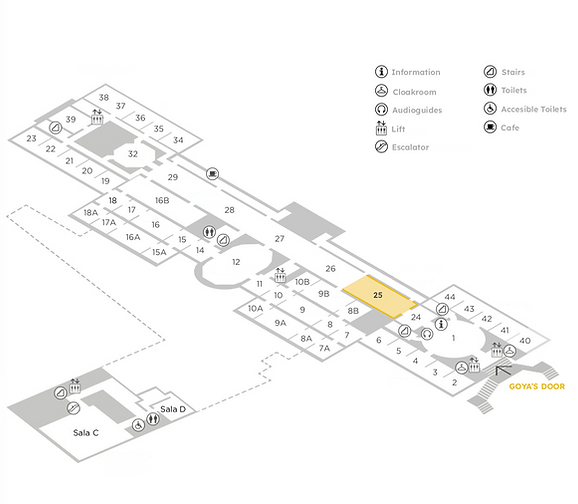
ROOM 025
Floor 1
THE WASHING OF
THE FEET
Tinttoreto


You are looking at a guide about faith. In these paintings, the main idea is the human need to believe in something divine. This belief gives us hope and the strength to continue living in a world full of fears and dangers. This guide focuses on the Christian tradition and its famous artworks.
This specific painting, "The Washing of the Feet", shows us how we should behave to achieve a divine reward, according to the Christian faith. It is a message that seeks to correct our human imperfections linked to original sin.
Did you know that...
Curiosity 1
This painting was originally designed for the right wall of the Church of San Marcuola in Venice. It is a "twin" to another work by the same artist: The Last Supper. This explains the lateral position of the elements and characters; the goal was for the churchgoers to see the scene perfectly from their seats without having to move.
Curiosity 2
Because of this unique perspective, the center of the painting is not Jesus, but a dog. Throughout history, this dog has been given different meanings, such as a symbol of fidelity and loyalty. However, it is likely that Tintoretto placed it there simply to fill the space and add a touch of everyday life to the scene.
Curiosity 3
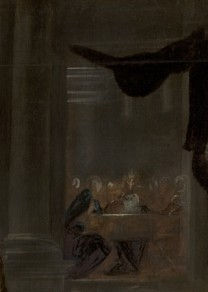
A very curious detail is that you can actually see the scene of the Last Supper within this painting. It is located in a different room in the background, on the right side, just above Jesus. It serves as a visual reminder of the event that is about to happen next.
Painting audio guide:
Audio made by Miguel Catalán highschool students Adriadna and Marta
Audio transcription:
“In this short audio guide, we are going to analyze the masterpiece The Foot Washing, which is one of Tintoretto's most important paintings. It was created around the year 1548. Tintoretto's real name was Jacopo Robusti, but people from his hometown called him Tintoretto, which means 'the little dyer', because his father worked dyeing fabrics. He was born in Venice in 1518 and died there in 1594. Tintoretto became famous for giving a lot of energy, movement, intense contrast of light and darkness, a powerful and almost theatrical atmosphere to his religious scenes. Today, the painting is in the Prado Museum in Madrid, in room 25. It is a very large oil on canvas. It measures about 210 centimeters in height and more than five meters in width, which makes it a monumental composition. The scene depicts a moment from the New Testament, which is just before the Last Supper, when Jesus washes the feet of his disciples. In this painting, Jesus is washing St. Peter's feet as an example of humility and service to others. This action represents humility, love, and self-sacrifice. One of the most interesting aspects of the painting is the composition. Instead of placing the main figures in the center, Tintoretto uses a strong diagonal line that looks almost like a stage. This diagonal begins with Christ and St. Peter, continues along the long table and the apostles, and ends at the arch in the background, near the canal. The table crosses the room and most of the apostles appear in small groups in very natural poses: talking, eating, taking off their sandals or adjusting their robes. In the foreground, we can see Jesus kneeling on the ground, dressed in a white robe, while he is washing St. Peter's feet. A soft light illuminates him more clearly than the surrounding figures, highlighting his divine nature. His expression is calm and focused, and his posture is humble but dignified. His body bends forward in an act of service, reinforcing the Christian theme of humility and self-sacrifice. In the background, there are other disciples and apostles eating or talking. Some servants are positioned mainly along the sides and near the back of the room, carrying water, preparing basins or attending to the table. A small dog lying in the center of the floor adds an everyday and lively touch to the scene. The space is depicted as a large open interior with high ceilings and arches. The architecture in the room gives a strong feeling of depth and perspective and makes the scene look realistic. A curious detail is the table. At first, it looks like it is in a strange position, but when the viewer moves, it seems to turn and follow them. Tintoretto did this on purpose so that the viewer could feel inside the scene. In conclusion, The Foot Washing combines a religious theme with dramatic light, an original perspective, and a lot of movement. It clearly shows Tintoretto's energetic and creative style."
To know more follow...
@here.you_art