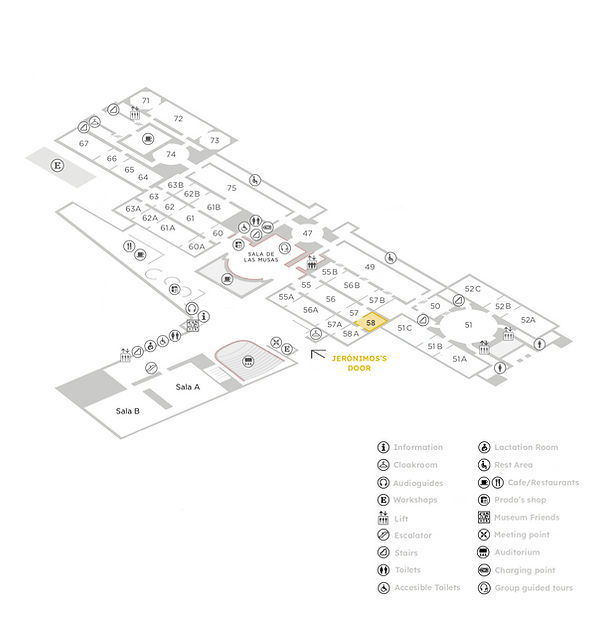
A VISUAL GUIDE THROUGH PRADO MUSEUM
ROOM 058
Floor 0
THE DESCENT FROM
THE CROSS
Van der Wayden


You are looking at a guide about faith. In these paintings, the main idea is the human need to believe in something divine. This belief gives us hope and the strength to continue living in a world full of fears and dangers. This guide focuses on the Christian tradition and its famous artworks.
This specific painting, "The Descent from the Cross", shows us how sacrifice is a fundamental part of salvation, according to the Christian faith. It also teaches us that our actions have consequences.
Did you know that...
Curiosity 1
This painting was commissioned for a church in Leuven by the Guild of Crossbowmen. Because of this, you can see several representations of crossbows throughout the work. Some are literal, like the decorative shapes in the corners, but others are symbolic, such as the curved position of Jesus’ and Mary’s arms.
Curiosity 2
An important detail is the skull located at the feet of Saint John. There are several theories about it, but the most popular one is that it represents the skull of Adam (the first man). It symbolizes "original sin," and its presence shows that humanity is saved thanks to the sacrifice of Jesus.
Curiosity 3
The position of the characters is very intentional. Together, they form the shape of a parenthesis. The shape is "opened" by Saint John on the left (the only character with bare feet, as apostles were usually painted) and "closed" by Mary Magdalene on the right. this layout forces our eyes to focus on the main scene: Jesus and the Virgin Mary.
Painting audio guide:
Audio made by Miguel Catalán highschool students Miriam, Julia and Maria
Audio transcription:
“We are in room 49. We can see in this painting a very emotional moment from the life of Jesus. The Descent from the Cross was created around 1435 by Rogier van der Weyden, a famous Flemish painter from the 15th century. Today the painting is part of the collection of the Prado Museum in Madrid. Originally it was made for a church in Leuven, Belgium. The work shows the instant when Jesus' body is taken down from the cross after his death. Van der Weyden used oil on wood, a very popular technique at that time. This technique allowed him to create strong, bright colors and very precise details. The whole scene looks almost like a carved sculpture placed inside a golden frame. All the figures are very close to each other and their sadness feels intense and real. With this painting, Van der Weyden wants the viewer not only to see the story, but also to feel the pain and emotion behind it. We can see Jesus in the center of the painting, already dead, being carefully lowered from the cross by Joseph of Arimathea and Nicodemus. Beside him, the Virgin Mary faints in sorrow. Their bodies have a very similar shape, which shows the deep connection between mother and son and the pain they share. Around them we can find other important figures such as Mary Magdalene and Saint John, all expressing strong emotions. The colors also help us understand the meaning: the red suggests blood and sacrifice while the blue symbolizes the purity of the Virgin Mary. Van der Weyden painted every face and every piece of clothing with incredible attention. We can observe every fold, every tear, every expression. The composition is very balanced and it almost feels as if time has stopped. The goal of the artist was not only to tell a religious story, but to show real human emotion. We can see how Rogier van der Weyden, who was born around 1399 in Tournai, Belgium, mixes emotion with realism. He learned to paint with Robert Campin, another important Flemish artist. Van der Weyden became famous for creating works that combine technical skill with deep feeling. During the 15th century, religion was a very important part of daily life. Art helped people pray, to feel closer to God. The Descent from the Cross reflects this idea very clearly, because it is full of faith, sadness and devotion. This painting is strongly connected to its historical context when religious images were essential for spiritual reflection. At the same time, it reminds us of universal human emotions like love, suffering and compassion. To conclude, this work is remarkable because it brings together beautiful technique, strong meaning and powerful emotion. That’s why The Descent from the Cross is considered one of the greatest masterpieces of the Flemish period and one of the highlights of the Prado Museum."
To know more follow...
@here.you_art